Your system has many interfaces. Can you see them all?
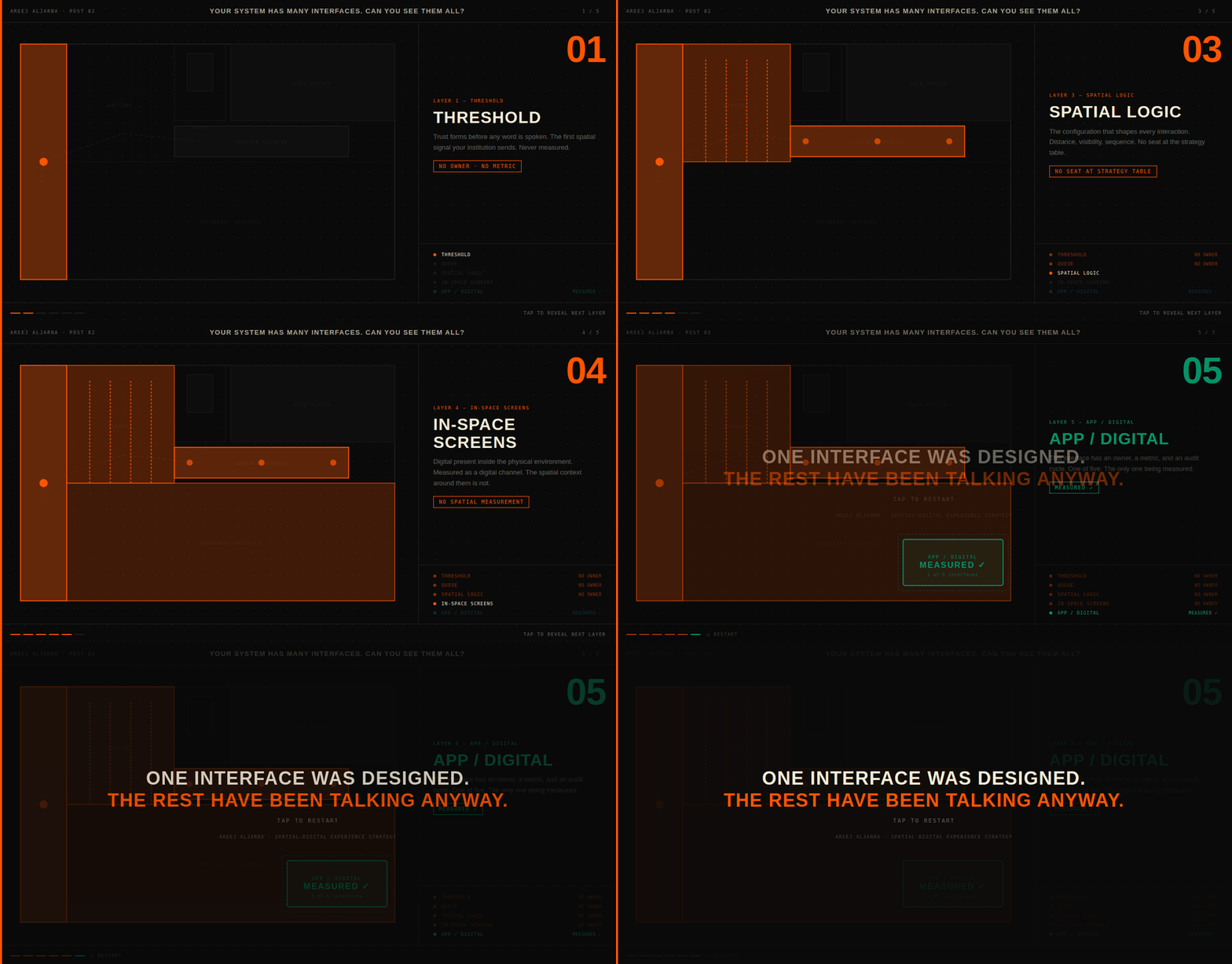
You formed a judgment about the institution before you spoke to anyone.
The threshold told you something. The queue told you something. The distance between you and the counter, the effort required to find where to stand, the quality of light in the room you waited in. All of it was communicating, continuously, below the level of conscious attention. By the time you reached the first designed touchpoint, the verdict was already forming.
This is not a new observation. Mary Jo Bitner named it in 1992, documenting how physical environments signal institutional identity before any service interaction begins. What followed was decades of empirical research across fields that rarely speak to each other, museums, hospitals, banks, government buildings, confirming the same pattern: spatial configuration predicts behaviour. Where people move, how long they stay, what they encounter, what they trust. In one of the more striking findings from this body of work, spatial layout in office environments predicts who communicates with whom more accurately than organisational charts do.
The building type does not change the logic.
A museum visitor who cannot read the layout will miss entire collections regardless of their quality. A citizen navigating a government service building designed around back-office workflow rather than human movement will arrive at the counter already worn down. A bank customer who queues in a configuration that signals the institution's time matters more than theirs will bring that reading to every subsequent interaction.
And this holds even in spaces where digital is already present as a built layer. Research on digitally augmented environments shows that spatial configuration continues to govern movement and encounter independently. Kiosks, interactive screens, and self-service devices inside buildings are measured as digital channels. The spatial journey that brings a person to those devices is not. The score reflects the interaction quality. It does not capture what the space communicated on the way there.
What typically happens next is familiar to anyone who has worked inside these institutions. More signage gets added. A digital wayfinding system is commissioned. A guide is placed at the entrance, a person whose entire role is to compensate for what the space failed to communicate. Each layer adds cost. And the question worth asking: does placing someone at the door treat the root, or make the workaround permanent?
In the previous post in this series I wrote about the problem with digital transformation in physical institutions. If you want to locate where your institution sits, the self-diagnostic assessment in that post is a useful starting point.
Service design and user experience design built their accountability structures around digital. Journey maps begin at the app. Audits measure clicks and drop-off rates. Omnichannel frameworks name physical as a channel and then operationalise it through logistics and data systems inside buildings. The spatial layer, its configuration, its social logic, the digital devices embedded within it, has no owner, no metric, and no seat at the strategy table.
One of the foundational principles of user experience design is that systems should reflect real-world logic. Which means a coherent digital experience presupposes a coherent spatial logic to reflect. If the building speaks a contradictory language, the digital experience inherits that contradiction before a single line of code is written.
When I raise this, the instinct is often to read it as a spatial argument and hand it to the architect or the operations team. It is not. Spatial configuration is the mechanism. The failure is a governance one.
Scores may reflect genuine digital excellence. When the branch or service centre visit tells a different story, that is not an exception to be explained. It is a signal pointing to a layer that has not yet entered measurement frameworks. No one in the organisation is accountable for what the space is communicating. No one is measuring the gap between what the institution intends to say and what the person walking through the door actually lives through.