What happens to UX when a design researcher studies space?
I recently delivered my first talk about my trajectory, following my return from London and the completion of my second master’s degree. What became immediately visible was not confusion, but a familiar structural impulse: the need to locate a person, a practice, or a body of work cleanly inside a category, a role, a label. That impulse and the tension it reveals pushed me to reflect not on what I do or who I am, but on how I communicate and narrate my thinking.
Leonardo da Vinci wrote:
“Study the science of art. Study the art of science. Develop your senses, especially learn how to see.”
This sentence captures the essence of my practice more precisely than any professional label. Not as a metaphor, but as a method.
My educational foundation began in information management and human–computer interaction. I went on to practice user experience and service design, and worked in innovation management. Along the way, as I encountered experiences that were inherently hybrid, unfolding across digital and physical channels, my curiosity expanded beyond interfaces and systems toward space itself: how environments, particularly digitally augmented ones, shape human behavior, perception, and meaning.
I followed that curiosity deliberately. These were not detours. No direction was abandoned. Each step added a lens.
When you work with me, whether you hire me, collaborate with me, or interview me, you are not engaging with a single discipline. You are engaging with the synthesis of all of them. I can, of course, speak fluently about any one domain when context requires it. But the value I bring does not live inside isolated categories such as “digital experience” or “physical experience.” It emerges in the space between them, where parts and wholes are considered simultaneously, not as separate components but as an integrated system.
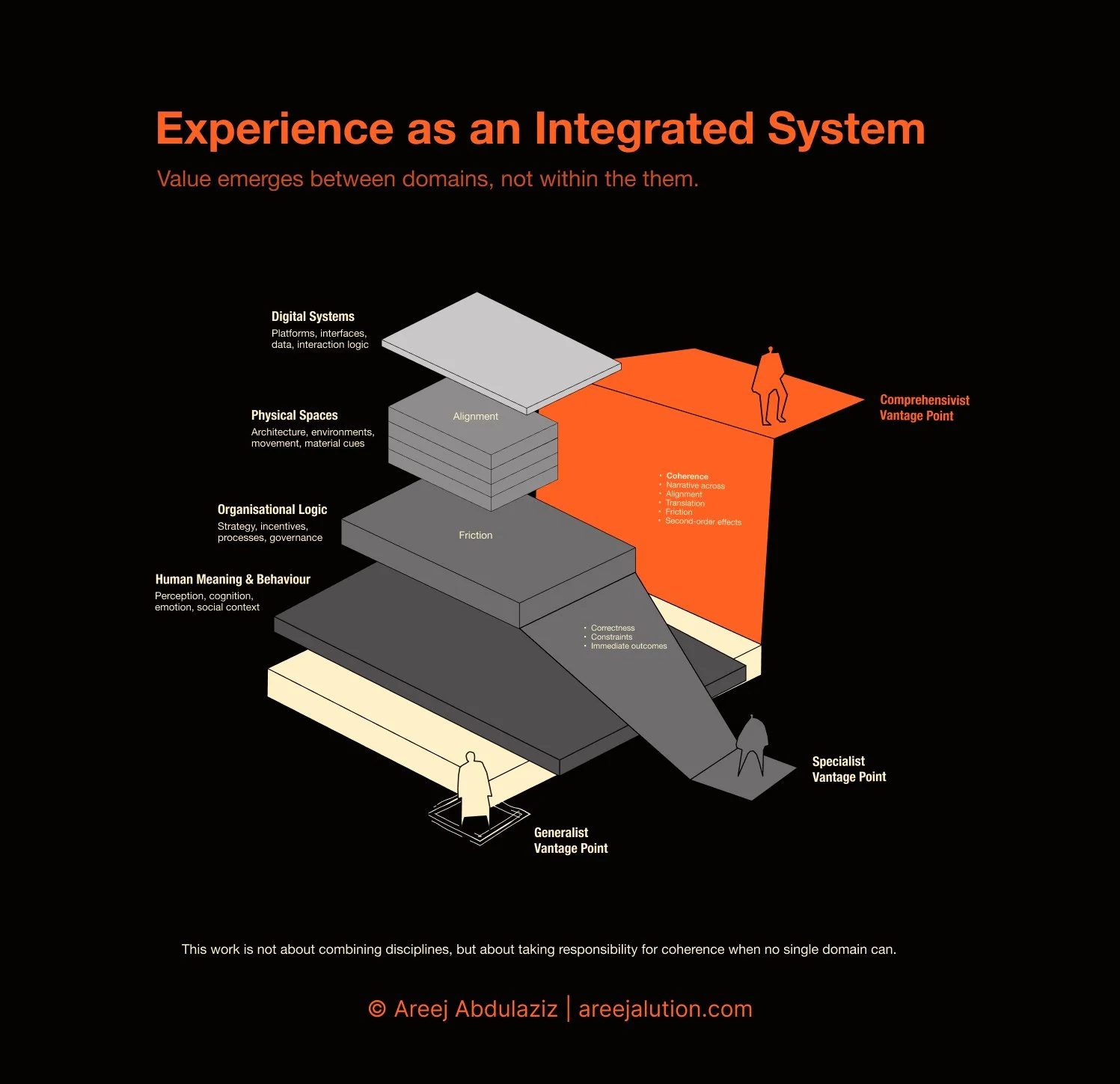
This requires a vantage point outside any single discipline, one that holds responsibility for coherence across digital, physical, and organizational experience, ensuring that digital and physical work does not compete or fragment, but reports into a shared logic of use, meaning, and behavior.
From this vantage point, my role is not merely to connect domains, but to take responsibility for coherence and to decide when perspectives conflict.
To borrow a metaphor: the value is not in isolating individual strands, but in how they are woven.
Between the enforced binary of generalist and specialist, there is another stance. Borrowing Buckminster Fuller’s term, I call it being a comprehensivist.
I use the term not to signal breadth, but to name a mode of responsibility: the obligation to hold coherence across domains when no single discipline can.
This is not the absence of expertise, nor a surface-level familiarity with many things. It is a response to what disappears inside departmental silos: systems, patterns, and second-order consequences that cannot be seen from within a single frame.
A comprehensivist has the ability to move from depth into breadth and back again. This movement is not loose or unfocused. It stretches across domains without losing tension, like a rubber band that expands and then snaps back to precision. The stretch is only possible because there is substance and elasticity at the core. Specialization provides the anchor; comprehensivism provides the range. This is not generalism. It is a different mode of rigor altogether.
Dual thinkers and trans-disciplinary minds inevitably introduce ambiguity. Markets tend to resist ambiguity. Corporations tolerate it only once it can be packaged. Society often celebrates it retroactively, once it has become safe. My work currently sits inside that tension.
I do not aim to hide contradiction or fragmentation, nor could I, as a researcher, claim that what I am doing is anything other than experimental. I make this journey visible by design. Integration does not happen by pretending complexity isn’t there; it happens by examining where things don’t yet fit, and asking why. In practice, this work translates into decisions, structures, and experiences that align strategy, space, technology, and human behavior under real constraints.
Being a comprehensivist requires honesty about complexity, not the performance of false coherence.
I do not want to be pigeonholed by a label.
That isn’t a refusal to commit.
It is a refusal of simplification and reduction.