Read the News Like a Futurist
There is a particular kind of helplessness that sets in when you watch a crisis unfold in real time and cannot tell what it means. Not what happened. The news will tell you that. But what it means for the next week, the next month, the shape of your daily life. I live in Riyadh. In March 2026, as the situation in the region intensified and the Strait of Hormuz became the center of something I could not fully parse, I found myself doing what most people do: refreshing feeds, reading headlines, trying to assemble a coherent picture from fragments that were not designed to cohere.
At some point I stopped. Not because the news stopped. It did not, but because I recognized that I was asking it to do something it cannot do. News reports events. It cannot tell you which future you are moving toward, or what signals actually matter, or whether the thing that feels stable is stable or just slow. For that, you need a different kind of thinking.
So I opened my toolbox. I pulled out Foresight, Futures thinking. It is a set of structured methods for navigating uncertainty. It is taught in design schools, used by strategy consultants, embedded in policy planning. It is almost never described as something a private person might use to understand their own situation. I want to argue that this is a mistake, and that the tools work just as well when the stakes are personal.
Refuse the wrong question
When a crisis breaks, the instinctive question is: who will win? It feels like the right question because it promises resolution. But it is analytically useless for anyone trying to make decisions, because it assumes a clean ending, ignores everything in between, and offers no guidance about what to do now. The correct question, the one that foresight is designed to answer, is different: which futures are plausible, what would each one feel like from where I stand, and what signals would tell me which one is unfolding?
Reframing the question this way is not a small thing. It shifts you from spectator to analyst. It forces you to think about your own position in the scenario space, not just the actors on the stage. For me, the right question was: which futures are most likely to affect Saudi Arabia's security, economy, and daily life over the next two to twelve weeks, and how would I know which one I am in?
Map the uncertainty
Not all unknowns are equal. Some variables are relatively predictable; others will determine everything. Foresight methodology asks you to identify the two uncertainties that matter most and use them to structure the scenario space. In this case, the two axes were clear: whether Saudi Arabia maintains defensive containment or gets drawn into active participation, and whether the situation remains regionally bounded or expands into a multi-front, system-level event. These two axes generate four quadrants, and the scenarios live inside them.
This step has an immediate clarifying effect. Instead of tracking every development as equally significant, you are now watching for movement along two specific dimensions. Most of what appears in the news is noise relative to those two questions. The discipline of naming the axes forces you to decide what actually determines the future you are heading into.
Understand the system, not just the events
This is where futures thinking departs most sharply from ordinary news consumption. Headlines track military exchanges and diplomatic statements. But the actual mechanism of disruption operates at a different layer entirely and it only becomes visible when you map the system as a whole rather than reading events one at a time.
The Strait of Hormuz carries roughly 20 to 21 million barrels of oil per day, about a fifth of global supply. The instinct is to think of disruption in physical terms: a blockade, a mine, a closed channel. But the system was not failing because of a physical blockade. It was failing because of insurance and market behavior.
War-risk premiums at Lloyd's of London surged from negligible fractions to high single-digit percentages of hull value. P&I clubs, the mutual insurers that provide liability coverage for most of the world's commercial fleet, began issuing cancellation notices for Gulf operations. Maersk imposed emergency surcharges and suspended bookings. The result was something that functions like a blockade without being one: a contractual chokepoint, where ships stop moving not because the water is physically impassable but because no one will insure the voyage. The strait was technically open. The system was effectively closed.
If you are watching for a physical blockade, you will consistently misread what is happening. The real control point is a London underwriting market repricing risk in real time. That is not visible in event-by-event news reading. It only appears when you map the system.
The system produced a second counterintuitive finding. Saudi Arabia's East-West pipeline and the Yanbu terminal on the Red Sea exist as bypass routes, partial relief valves if Hormuz becomes untenable. But rerouting concentrates traffic onto fewer, more exposed nodes. Yanbu becomes a higher-value target precisely because the system is depending on it more. Resilience mechanisms create new vulnerabilities. This is the bypass paradox, and it is a product of systems thinking, not news consumption.
Build scenarios from the uncertainty, not predictions from the events
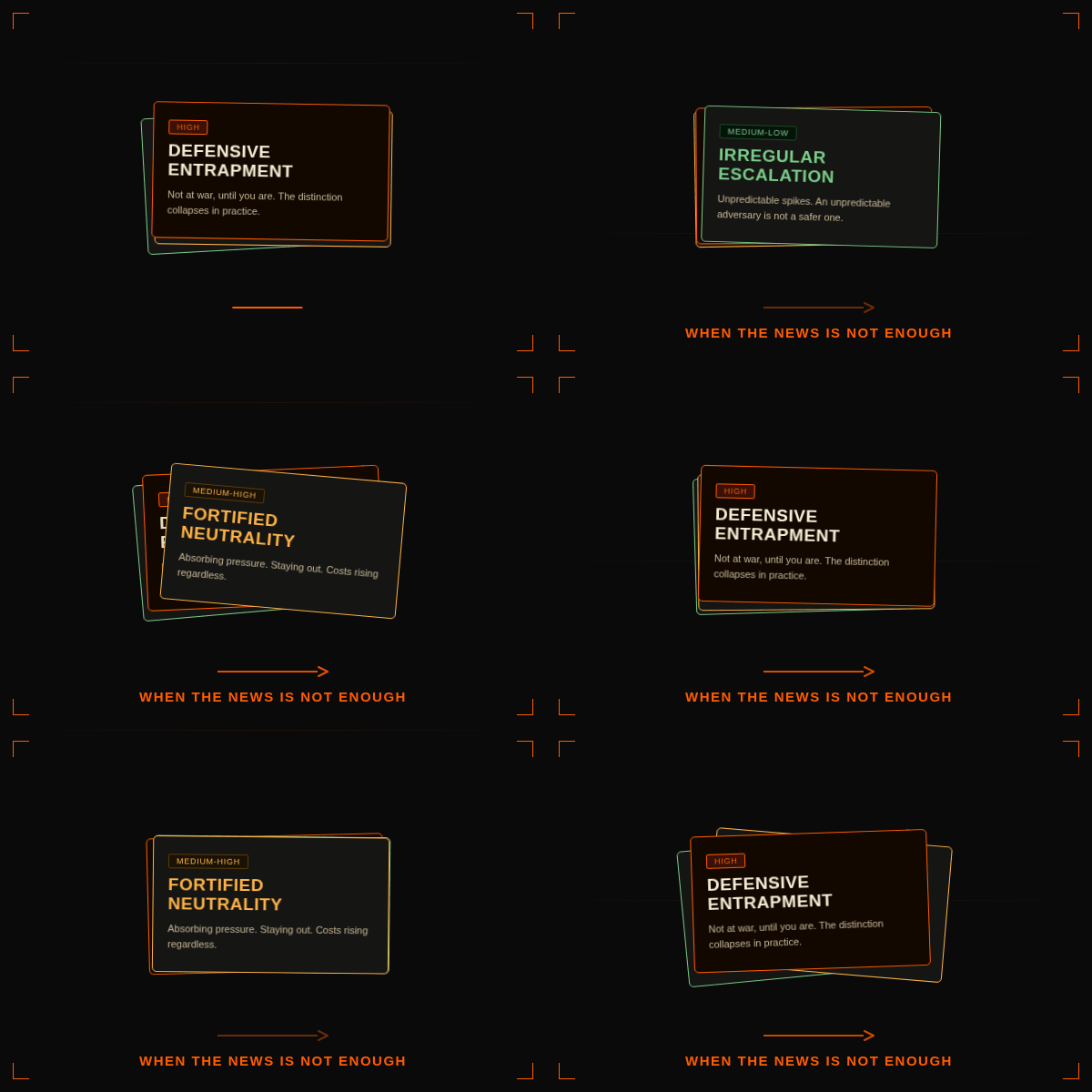
Once you understand the system, you identify the two uncertainties that will determine how it evolves and build the scenario space from them. Six plausible futures emerge, each a combination of Saudi posture and war scope, each with its own internal logic, signals, and implications for daily life.
Running through all six is a distinction that almost never appears in news coverage: the difference between disruption and damage. Disruption means delay. Ships reroute, prices spike, but capacity is intact and recoverable. Damage means capacity removal. When regional energy infrastructure sustains strikes serious enough that repairs are measured in months rather than days, the time horizon of the entire situation shifts. That is not disruption. It is damage. And it changes what any of these scenarios actually feels like to live inside.
Build a signal dashboard, not a news feed
Scenarios are only useful if you can tell which one you are moving toward. That requires watching specific, observable signals, not everything, but the right things, organized by what they actually indicate. The point is not to achieve certainty. The point is to replace the ambient anxiety of consuming all news with the focused attention of watching a defined register.
When war-risk premiums spike and P&I cancellation notices appear, that is the earliest warning the system is tightening, and shipping disruption follows shortly after. When Saudi official rhetoric shifts from stability messaging toward direct source identification, that is the political signal moving, a leading indicator for everything else. This is how the tools change the reading experience. You are no longer reacting to whatever the algorithm surfaced this morning. You are watching a defined register and updating your assessment as signals move through it.
The dashboard does not tell you which scenario is unfolding. That is your call. Read the signals below against what you are seeing in the news right now, then look back at the six scenarios. Which pattern does it match?
| Signal | Green — stable | Amber — rising risk | Red — high risk |
|---|---|---|---|
Interception frequency Military |
Rare or absent | Frequent, reported publicly | Constant or escalating |
Infrastructure strikes Military |
None | Attempted, intercepted | Successful or repeated |
War-risk insurance Financial |
Low or stable | Spiking, P&I notices issued | Cover withdrawn, shipping halted |
Shipping and logistics Physical |
Normal flow | Delays, surcharges imposed | Severe disruption, rerouting |
Saudi official rhetoric Political |
Calm, stability messaging | Firm, direct source identification | Escalatory security language, coalition signaling |
Daily life disruption Civilian |
None | Minor, intermittent | Persistent, normalised |
Red Sea / Houthi activity Regional |
Contained | Expanding, new incidents | Active multi-front pressure |
Now scroll back to the scenario cards. Where do your signals land? Green across most rows points toward Fortified Neutrality. Amber clustering in military and physical signals points toward Defensive Entrapment. Red in shipping and insurance before anything else points toward Two-Chokepoint pressure building. You are reading the situation. The methodology just gives you a structure to do it with.
I am a researcher and strategist by training. I work with foresight and systems methods professionally. I want to be honest about what that means for this piece: the analysis here draws on years of practice with these tools, and I would not pretend otherwise. But the underlying logic is not sealed off from people without that background. Understanding how scenarios are built, what signals to watch, and why the framing question matters, that is transferable. You do not need to run the full methodology to read the world differently because of it.
The hybrid approach I used, scenario planning as the core structure, game theory as an analytical layer for understanding actor incentives, the Cone of Futures to organize outcomes by likelihood and impact, sounds technical. In practice it is a set of disciplined questions: what are the two things I genuinely do not know that will determine how this unfolds? What would each combination of answers look like? What would I actually observe if I were inside each scenario? What signals would tell me I had moved from one to another?
These questions are available to anyone. They do not require expert panels or institutional access. They require a willingness to sit with uncertainty long enough to map it, rather than reaching for the nearest confident prediction.
The news will keep reporting events. Some of those events will be significant; many will be noise amplified by the perception-behavior loop, the dynamic where a narrative about crisis accelerates risk-averse behavior that produces the actual disruption it was describing. Narratives about what is happening move markets and behavior before the facts are fully established. That is not a failure of information. It is a feature of how complex systems under stress actually work. Understanding it is not the same as being immune to it, but it is better than not understanding it.
I live in Riyadh. This is not an abstract exercise for me. The scenarios I mapped are the scenarios I am watching. The signals I track are the ones that will tell me whether the situation is stabilizing or shifting. The insight I arrived at, the central risk is normalization, not explosion, shapes how I read each day's news, and what I do with what I read.
Foresight tools were not designed for this use. They were designed for institutions planning at scale. But the underlying logic, structure your uncertainty, map the system, watch the right signals, is not institutional property. It belongs to anyone who needs to think clearly under pressure.
That turns out to be most of us, most of the time.